CLIMATE-RELATED DISCLOSURE
In September 2022, Bursa Malaysia revised the Main Market Listing Requirement to elevate the
sustainability practices and disclosures (Enhanced Sustainability Disclosure) of listed
entities. Their practice note requires climate-related disclosures to be prepared and
aligned with TCFD recommendations by the financial year ending 31 December 2025 onwards. As
a public limited company on the Main Market of Bursa Malaysia Securities Berhad, KLCCP
Stapled Group, encompassing KLCCP and KLCC REIT Management Sdn Bhd (KLCCRM), is obligated to
disclose common sustainability matters in our 2024 documents, and gradually move towards
TCFD-aligned climate disclosures for the financial year ending (FYE) on or after 31 December
2025. To satisfy this requirement, as well as to meet stakeholders’ expectations for
transparent climate disclosures, KLCCP Stapled Group conducted a materiality assessment,
where Climate Change and Energy Management are ranked as priority environmental, social and
governance (ESG) topics with high materiality for KLCCP Stapled Group’s ESG Strategy.
KLCCP Stapled Group recognises the urgency of addressing climate change and its impacts on
the company’s financial performance through relevant action, as well as on reporting on our
initiatives in line with Bursa Malaysia’s requirement for mandatory TCFD disclosures.
Initiatives undertaken in this regard are therefore recorded in this document, including
support provided of an external consultant to assess and address climate-related risks and
opportunities.
A comprehensive gap analysis conducted in 2023 identified areas for improvement in our
climate risk management and disclosures based on TCFD recommendations as well as
industry/market good practices. These gaps were subsequently addressed via measures
including:
- Scenario analysis on transition and physical risks and opportunities and their financial
implications on the Group’s business and value chain
- Identification of possible risk mitigation and adaptation actions
- Enhancement of existing governance, strategy and risk management systems to incorporate
climate-related considerations
- Capacity building of management team on financial impacts of climate risks and their
respective roles and responsibilities in climate governance structure
In September 2024, the Securities Commission announced the National Sustainability Reporting
Framework (NSRF), requiring Main Market listed companies with market capitalisations of more
than RM2 billion to disclose in accordance with IFRS S1 and S2 starting in 2025, with full
adoption of the standards by 2027. Bursa Malaysia had also revised it’s Main Market Listing
Requirements in December 2024, with the requirement to align with TCFD recommendations
disapplied and substituted with IFRS S1 and S2. KLCCP Stapled Group, while maintaining the
alignment with TCFD recommendations in our climaterelated disclosure for the year under
review, will pursue IFRS S1 and S2 disclosures in phases, considering the reliefs allowed
within the NSRF, and leveraging the data as well as systems put in place from earlier
preparations made for TCFD.
This first climate-related disclosure summarises the Group’s climate-related risks and
opportunities and the integration of the financial risks and opportunities into corporate
governance, strategy, risk management, metrics and targets.
The disclosure of financial information allows all parties to understand the potential
financial consequences of climate change to the reporting company, its investors and other
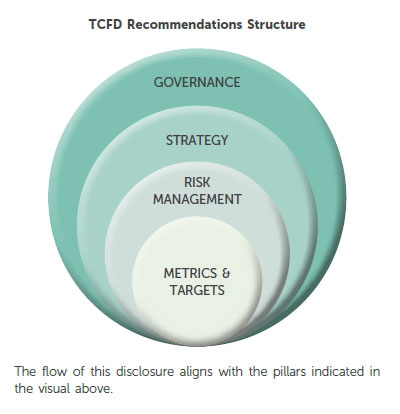
stakeholders. TCFD’s disclosure framework, conceptually similar to IFRS S2, comprises four
pillars: Governance, Strategy, Risk Management, and Metrics and Targets as shown below.
Collectively, the pillars provide insights into the reporting company’s management and
resilience strategy against climate-related financial impacts.
Governance
KLCCP Stapled Group’s commitment to sustainability and climate-related matters is firmly
rooted in our robust governance structure, which sets the governing elements and processes
as the foundation of sustainability integration. Decision-making processes take into
consideration sustainability risks, including overarching risks to the delivery of NZCE by
2050. Efficient governance serves to provide a common understanding and consistent approach
in managing related risks and opportunities stemming from climate change.
Climate risk and opportunities are also included in the ESG training plan which is explained
in detail on page 76 for different functions. In 2024, one training session was conducted on
14 December 2023 by an external consultant as part of the climate risk assessment.
The results of our climate risks and opportunities assessment, along with the narrative
statement within this report, were also presented to the top management of the Group during
an executive presentation on 16 April 2024.
Strategy
The effects of climate change are increasingly evident in the frequency and severity of
climate-related events such as floods, typhoons, heatwaves, forest fires and droughts, among
others. These have a pronounced negative impact on business and communities, often damaging
assets and disrupting business activities. At the same time, the transition to a lowcarbon
economy poses its own risks and opportunities, where transition ahead of other companies
presents business opportunities, whereas falling behind may result in financial and
reputational impacts.
For the Group, climate change may pose a risk to our assets, surrounding communities and
overall business model and value chain. Accordingly, we strive to enhance the durability of
our assets to build resilience and even seize opportunities arising from the low-carbon
economy transition, where possible.
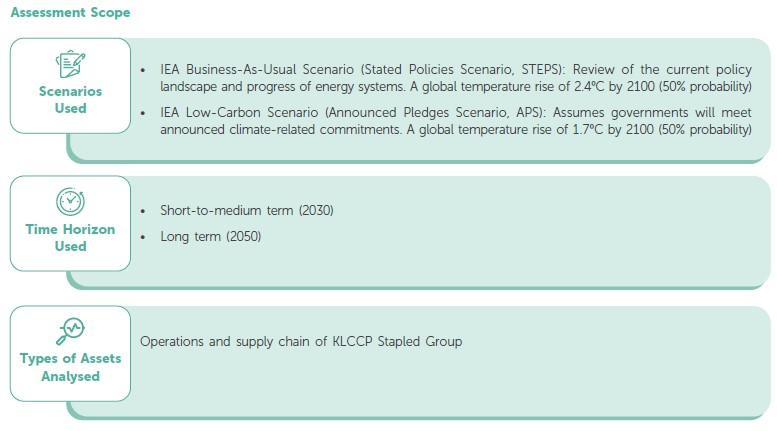
Guided by the SSC, each of our operating units conducted physical and transition climate
risks and opportunities assessments. The physical risk assessment used Shared Socioeconomic
Pathways (SSP) scenarios from the Intergovernmental Panel on Climate Change (IPCC)1, while
the transition risks and opportunities assessment was based on the International Energy
Agency (IEA)’s Stated Policies Scenario (STEPS) and Announced Pledges Scenario (APS).
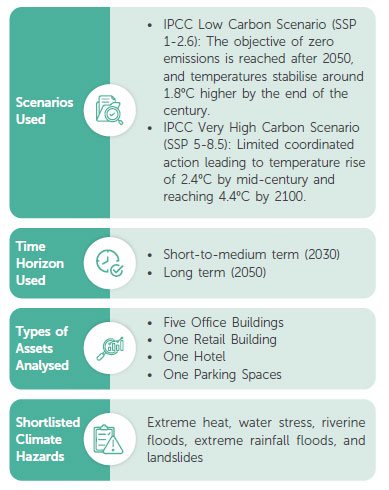
The Group has identified the following timeframes for physical and transition risks and
opportunities assessment: short-tomedium term (1-10 years) and long-term (>10 years). The
timeframes are intended to reflect potential climate impacts on the Group’s assets in their
useful lifetime – an average of 50 to 60 years.
Assessment Scope
We conducted a physical risk assessment on eight assets, examining a list of nine potential
climate hazards utilising the Low Carbon Scenario (SSP1-2.6) and High Carbon Scenario
(SSP5-8.5). Based on relevant climate hazards applicable to the scope of assessment, five
hazards were shortlisted with highest risk scores across short-to-medium term and longterm
horizons for further assessment.
Physical Risk Assessment Scope
Assessment Approach
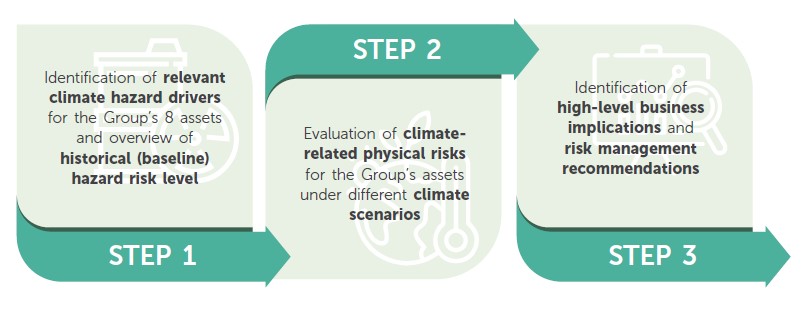
Acknowledging that physical climate change risks can have implications on our assets, KLCCP
Stapled Group prioritised 8 assets in Klang Valley to conduct a climate risk assessment
using a three-step qualitative physical risk assessment approach.
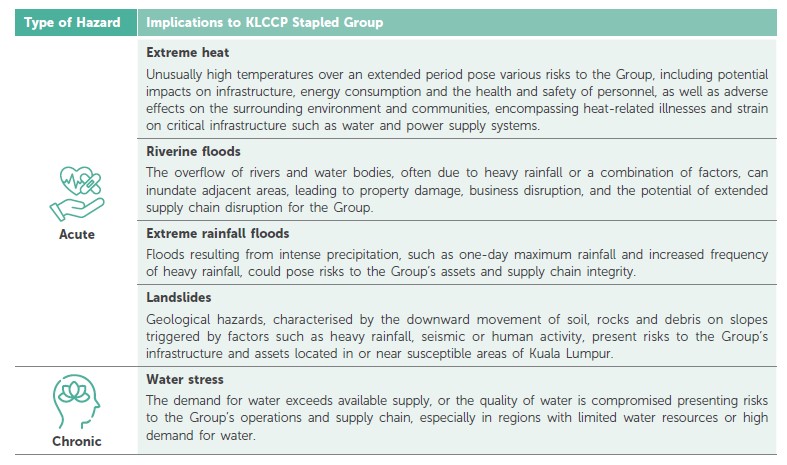
Physical Climate Risk Identified
For the physical risk assessment, the Group identified five main natural hazards that could
impact our assets, including both acute (event-driven) and chronic (long-term shifts in
climate patterns) hazards as identified below. These natural hazards pose risks of varying
severity to our assets and, therefore, our businesses.
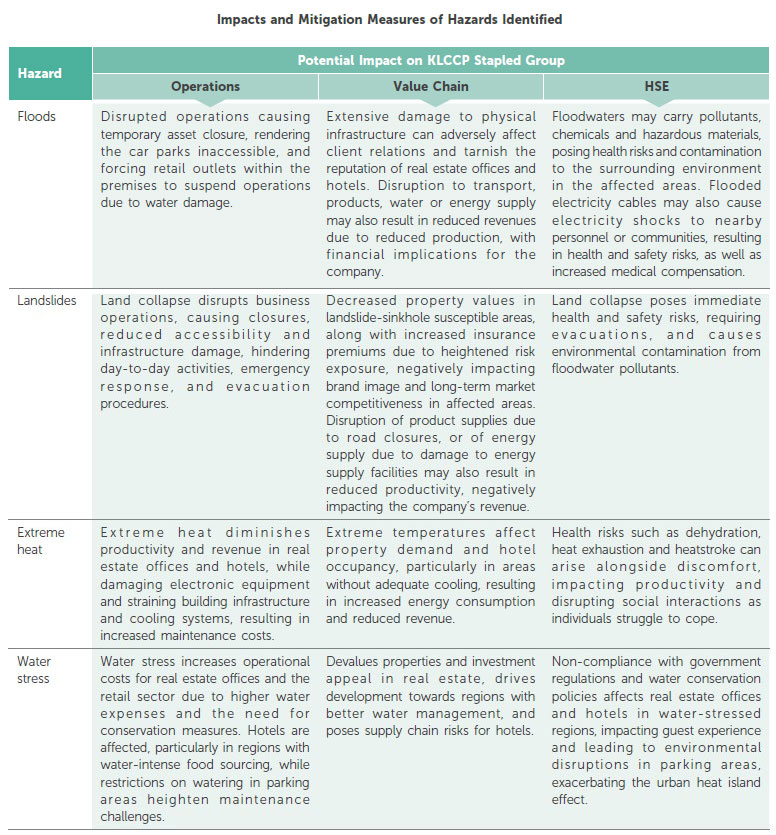
Potential Impacts on KLCCP Stapled Group Assets
Our assets will experience similar climate-related impacts as they are all situated close to
each other. The table below shows the impacts by type of hazard on the Group’s operations,
value chain and health, safety and environment (HSE).
TRANSITION RISKS AND OPPORTUNITIES
Assessment Approach
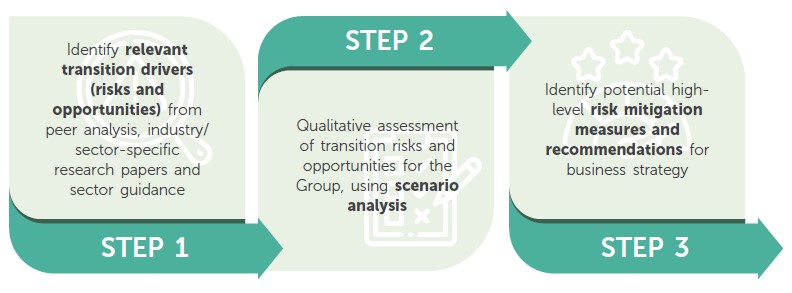
The scenario analysis on transition risks and opportunities was intended to comprehensively
analyse the Group’s exposure to potential impacts arising from a global transition to a
low-carbon economy i.e., an economy that is decarbonising. The transition risk and
opportunity assessment was a three-step qualitative process as indicated in the visual
below.
Transition Risk Assessment Approach
TCFD recommends that organisations disclose the resilience of their business strategies to
climate-related risks and opportunities, taking into consideration a transition to a
lower-carbon economy, where the low-carbon economy pathway is consistent with a 2°C or lower
increase in temperature by the end of the century, compared with pre-industrial levels. This
could lead to transition risks associated with increased operating costs due to more
stringent laws and regulations on GHG reduction, and higher demand for low-carbon technology
investment.
The Group sought to ensure that both upstream risks, such as carbon tax on suppliers, and
downstream opportunities, such as cost savings from energy efficiency or renewable energy,
were included in the analysis to ensure a holistic understanding of the transition risks and
opportunities.
An internal stakeholder consultation was conducted through a survey to support the
assessment. The transition drivers were evaluated by stakeholders on the impact of the
respective drivers on the Group’s businesses and value chain.
The Group has analysed the potential impacts on our business using globally recognised
climate scenarios from the IEA – APS as a low-carbon scenario, and STEPS as the
business-as-usual case.
Transition Risk and Opportunity Scoring for Assessment
Transition Drivers Identified
The Group has identified a list of transition risks and opportunities that are considered
relevant and used in scenario analysis.
Transition Scenario Analysis Results and Impacts on KLCCP Stapled Group
Assets
The scenario analysis on transition risks and opportunities aimed to assess the Group’s
exposure to potential impacts stemming from a global shift towards a low-carbon economy.
Through internal stakeholder consultations, The Group initially identified transition
drivers relevant to our operations and the supply chain.
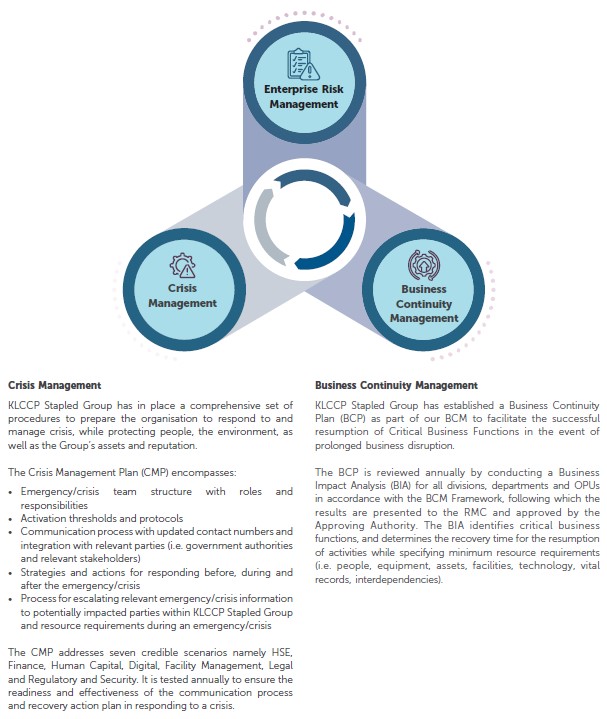
RISK MANAGEMENT
Risk management forms an integral part of KLCCP Stapled Group’s business and supports the
delivery of our strategy while underpinning the Group’s business model. Our risk management
policy and procedures are designed to embrace best practices, reduce the potential of
financial and nonfinancial risk exposure (including exposure to climate change risk), and
protect our assets and reputation.
The Boards provide direction by establishing sound risk management principles, guided by the
KLCC Group Enterprise Risk Management (ERM) Framework which outlines our risk governance,
risk assessment as well as risk monitoring and review processes. This framework provides a
standard and consistent approach to achieve full accountability in managing risks across the
organisation.
For more information on the KLCC Group’s ERM processes, please refer to the Statement on
Risk Management and Internal Control in the Integrated Report 2024 on pages 223 to 226.
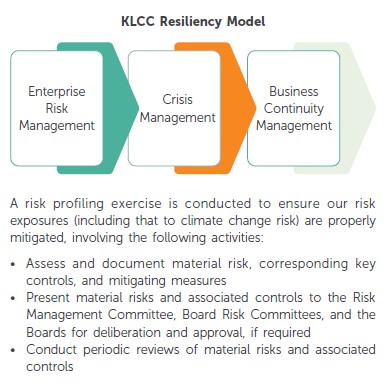
The KLCC Resiliency Model below provides an integrated view of the overall risk management
strategy in KLCC (including climate change risk), which is to reduce the likelihood and
impact of all identified risks, respond to immediate risk, and recover from prolonged
disruptions to meet business obligations. For more information on the KLCC Resiliency Model,
please refer to the Statement on Risk Management and Internal Control in the Integrated
Report 2024 on pages 223 to 226.
METRICS AND TARGETS
Climate-Related Metrics
The Group is determined to act on climate change to support the needs of the present and
future generations while protecting our business. As a first step, it is important to
establish measurable climate-related metrics for performancetracking purposes and set
measurable targets to ensure improvements in efforts to tackle climate change.
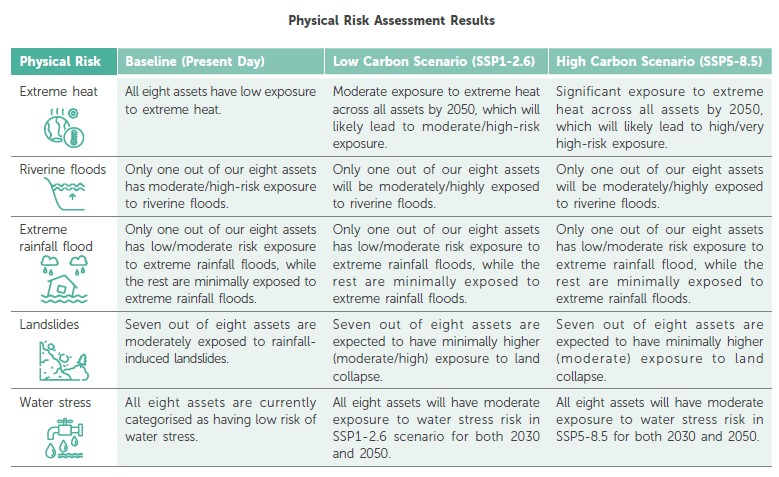
With regards to climate-related metrics, the following percentage of assets covered by the
physical risk assessment will be exposed to increasing risk from different hazards under
future climate scenarios compared with the baseline:
GHG Emissions metrics
In FY2024, KLCCP Stapled Group calculated our GHG emissions in accordance with “The
Greenhouse Gas Protocol - A Corporate Accounting and Reporting Standard (Revised Edition)”.
We report our GHG emissions using the Equity Share approach, which is based on
organisational boundaries.
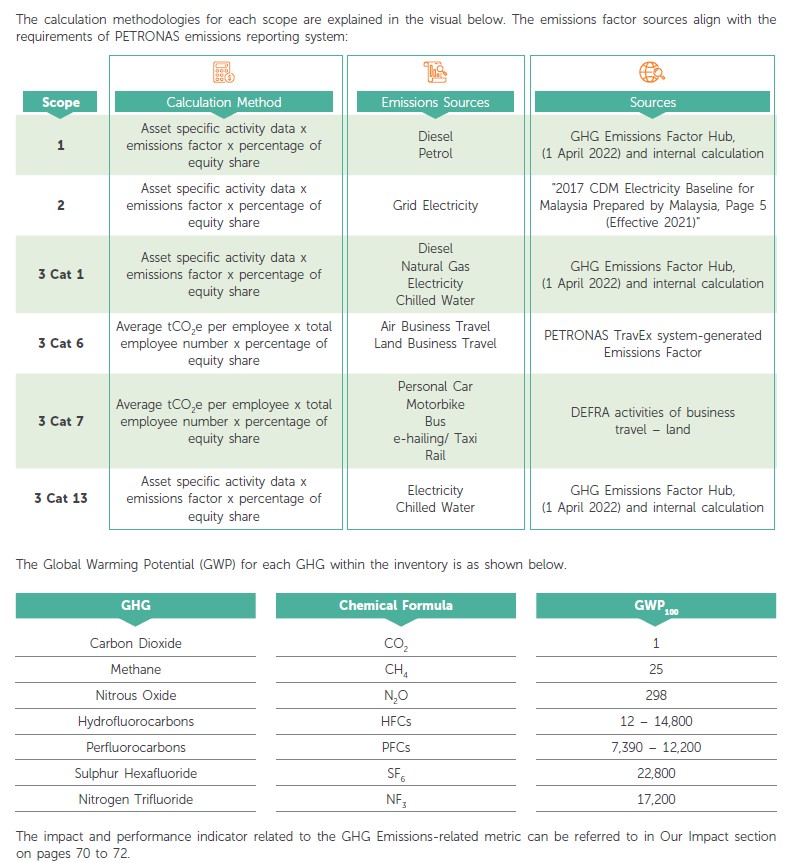
The Group monitors emissions from all our assets and operating units, covering the following
(the information below can be converted to visual representation):
GHG Emissions and Other Targets
KLCCP Stapled Group is guided by our Sustainability Plan 2030 as well as Net Zero Carbon
Emissions Pathway 2050 in defining our climate-related targets. The Group’s climate-related
targets are as follows:
Asset by Asset Decarbonisation Plan
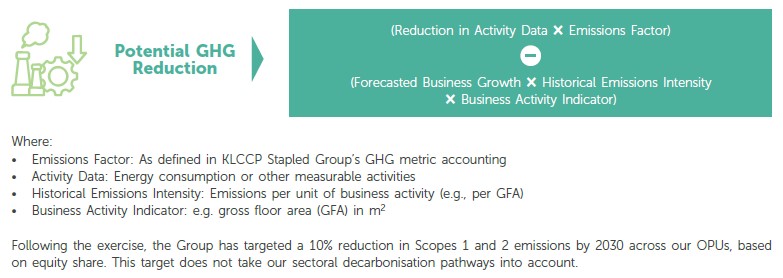
In 2024, all business segments undertook a thorough review to identify initiatives for
decarbonisation. The potential reduction from these initiatives were calculated and compared
with forecasted emissions up to 2030, providing bottom-up information on percentage of
reduction possible across the Group based on the following formula:
Energy Management
Energy management remains a critical focus for the Group as we navigate evolving market
dynamics in Malaysia. By integrating energy-efficient practices, we achieve cost savings
while advancing environmental sustainability, aligning with global efforts to combat climate
change.
PETRONAS Twin Towers (GBI Gold), Menara 3 Petronas (GBI Silver) and Menara Maxis (Silver)
serve as benchmarks for our commitment to green building standards. These certifications,
representing 60% of our office portfolio, reflect ongoing efforts to embed sustainability
within our built environment.
Our energy management approach prioritises reducing consumption through operational
efficiency and technological innovation. Initiatives such as retrofitting facilities with
energy-saving technologies have consistently improved energy performance.
Energy intensity is one of our goals under the Planet pillar of our Sustainability Plan
2030, with specific targets set for each segment.
Looking ahead, in compliance with the new Energy Efficiency and Conservation Act 2024, we
will explore ways to maximise our efficiency as well as reduce our consumption through
initiatives such as adopting RE. Our aim is to support Malaysia’s carbon reduction
objectives and reinforce our role as a leader in sustainable property management. This
commitment underscores our dedication to a lower-carbon future and resilient energy
management practices.
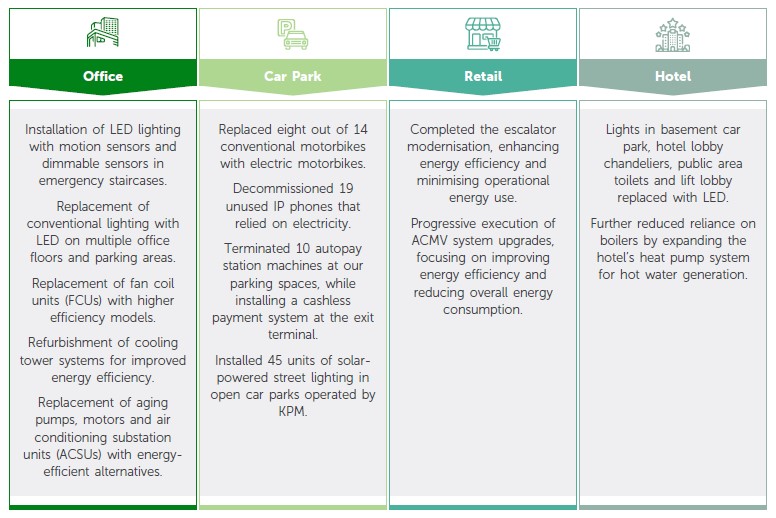
Key initiatives for Decarbonisation and Energy Management based on business segments in
2024:
Water Management
Water consumed across our office buildings, retail malls and hotel facilities is sourced or
withdrawn entirely from municipal water supplies with no use of surface or groundwater. All
discharged water from our facilities flows into municipal sewerage systems and is
subsequently treated by public sewage treatment plants (STPs) in compliance with local
regulations. As such, there are no specific effluent quality requirements applicable to our
organisation.
As part of our HSE policy, we are committed to the responsible use of resources and
continuously strive to enhance water efficiency in our operations. Our environmental impact
assessment includes resource use evaluations, ensuring potential risks related to water
consumption are identified and mitigated.
Additionally, all operations are evaluated to ensure they do not contribute to water
wastage. This includes the installation of water-efficient systems, the promotion of
non-wasteful behaviours among stakeholders, and appropriate controls to manage water
discharge impacts. For instance, MOKUL Hotel modernised their public washrooms with
water-saving sensor faucets and bidets, which reduces wastage, while improving hygiene and
comfort. While water recycling has not been implemented yet, we remain committed to
exploring innovative solutions to minimise water withdrawal and discharge.
Waste Management
Waste is categorised as hazardous or non-hazardous, adhering to the Environmental Quality
Act 1974 and the Solid Waste and Public Cleansing Management Act 2007.
Hazardous Waste
We comply strictly with Environmental Quality (Scheduled Waste) Regulations 2005 to manage
hazardous waste from generation to final disposal. Our practices include:
- Storing scheduled waste securely in appropriate containers to prevent spillage or
leakage, ensuring containers always remain closed.
- Leveraging the Electronic Scheduled Waste Information System (eSWIS) developed by the
Department of Environment (DoE) for lifecycle monitoring of waste from cradle to grave.
- Prioritising waste minimisation through reuse, recycling and recovery initiatives before
disposal.
- Ensuring compliant disposal practices through licensed contractors.
- Appointing Competent Persons to oversee hazardous waste management at each facility.
- Conducting routine inspections and assessments, including weekly Scheduled Waste Storage
Inspections, quarterly Functional Assessments, and annual Operating Legal Assessment
reviews.
- Promptly addressing non-compliance issues and sharing lessons learned to prevent
recurrence.
Non-Hazardous Waste
Our management of non-hazardous waste aligns with sustainability principles, with a focus on
reducing waste generation and promoting responsible disposal. Key initiatives include:
- Monitoring non-hazardous waste inventory at the building level using an internal
tracking system.
- Supporting the Malaysia Towards Zero Single-Use Plastic (SUP) Roadmap 2018-2030 by
eliminating SUPs during company meetings and events.
- Providing waste segregation bins in all office spaces and training cleaning staff on
effective waste segregation.
- Ensuring responsible non-hazardous waste disposal by appointing licensed transporters.
These efforts reflect our holistic approach to environmental stewardship, emphasising
compliance, innovation and collaboration for sustainable outcomes.
Efforts towards supporting circularity
Reverse Vending Machine
KLCCP Stapled Group, in collaboration with MISC and Janz Technologies, has installed a
Reverse Vending Machine (RVM) in the Kompleks Dayabumi vicinity. The aim is to drive
behavioural change in our employees towards recycling through education and incentives as
well as recover as many plastic bottles and cans as possible, diverting them from landfills
and oceans to minimise plastic pollution. This initiative aligns with the KLCCP
Sustainability Agenda and the UNSDG, supporting UNSDG 11: Sustainable Cities and
Communities, and UNSDG 12: Sustainable Consumption and Production.
This initiative aligns with the KLCCP Sustainability Agenda and the UNSDG, supporting UNSDG
11: Sustainable Cities and Communities, and UNSDG 12: Sustainable Consumption and
Production.
Fabric Recycling
Another collaboration between KLCCP Stapled Group, MISC and Pos Malaysia involves the
installation of a fabric recycling bin in 2023. In 2024, 1033.8 kg of fabric was collected,
demonstrating the programme’s effectiveness in:
Food Waste Digester
MOKUL Hotel utilises advanced food waste digestion technology, specifically the MAEKO LQ
Series system, to manage organic waste sustainably. This system processes food waste
on-site, converting it into liquid that is safely discharged into the drain and routed to
the sewage treatment plant (STP). Using this system, we eliminate the need for waste bins
and reduce the volume of waste sent to landfills, lowering our waste management costs and
minimising methane emissions. This aligns with efforts to integrate sustainable practices
into daily operations while supporting circularity by ensuring food waste is treated
responsibly and reintroduced into the water cycle through the STP.