
Miyeon Yi‘s work has echoes of the cinematic tension in Alfred Hitchcock’s Rear Window (1954). Her paintings reveal multiple spaces at once, inhabited by figures, animals, and plants that quietly interact with one another regardless of the physical boundaries separating them.
Arranged like props across different depths—background, middleground, and foreground—these characters prompt contemplation of the nuances of connection and isolation. Much like Hitchcock’s exploration of voyeurism and human relationships, Yi examines how her subjects communicate and coexist.
I met with Yi at her studio in Brixton, south London, where she’s been based since graduating from the Royal College of Art with an MA in Painting in 2023. It’s been a busy time for the South Korean artist, who recently returned from Paris after setting up her solo presentation with MOU PROJECTS, Hong Kong, at Asia NOW 2024.

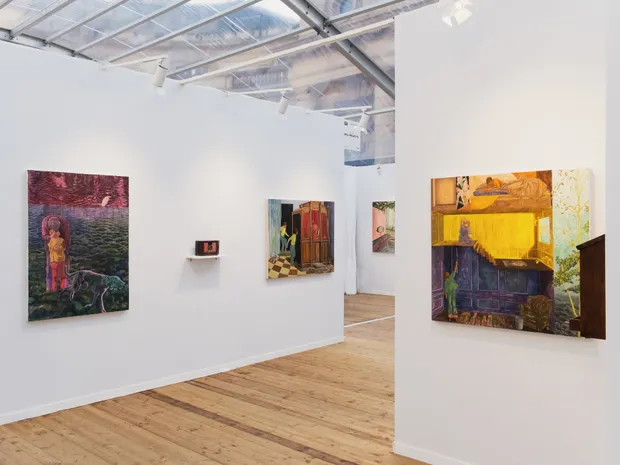
Time pauses for the hesitant (17–20 October 2024) comprised nine brightly coloured works in egg tempera and oil on wood. Ranging from large, dramatic scenes to tiny, intimate compositions, each piece is like a dollhouse split open, inviting you to delve into its peculiar mise-en-scène.
Born in Seoul, Yi has been painting since she was a child. Before moving to London in 2021, she spent several years in the U.S., where she became interested in film and theatre.
‘Film has greatly influenced how I convey narratives,’ she told me. ‘I’m fascinated by how the intention behind storytelling can change perspective.’ Yi shared that she connects with scenes in film that focus more on the environment and how characters move through it, rather than emotionally charged close-ups.
This influence appears in her paintings. ‘The focus is on the environment and the interactions within it rather than the individual characters,’ Yi explained. By minimising distinctive features to avoid drawing attention to her protagonists’ identities or emotions, she invites viewers to immerse themselves in the scene and interpret the unfolding narrative.
The theatricality in Yi’s work partly stems from her interest in Noh, a traditional form of Japanese theatre dating from the 14th century. In Noh design, the hashigakari is a bridge that connects stage to backstage, serving as a transitional space for performers and symbolising a shift between the real and spiritual realms.
Experiencing Noh theatre, Yi was struck by the audience’s ability to witness multiple events unfolding at once. ‘As a viewer, you can focus on the main stage or the figures in the background. Even before the curtain rises, actors interact backstage, blurring scene boundaries and maintaining a slow, deliberate pace.’
She reflects this theatricality in her paintings, dividing the picture plane into stages and backstages connected by abstract elements—like falling water or sound—that serve as bridges.
In Weeping ficus tree (2024), for example, she visualises sound through her characters’ reactions. In Noh theatre, crying is conveyed by hand gestures. Yi mirrors this by placing at the centre of the composition a figure with a raised hand who is otherwise emotionless. A figure on the floor below seems to be complaining about the noise, while another on the floor above appears to have just woken up, curious about the commotion.
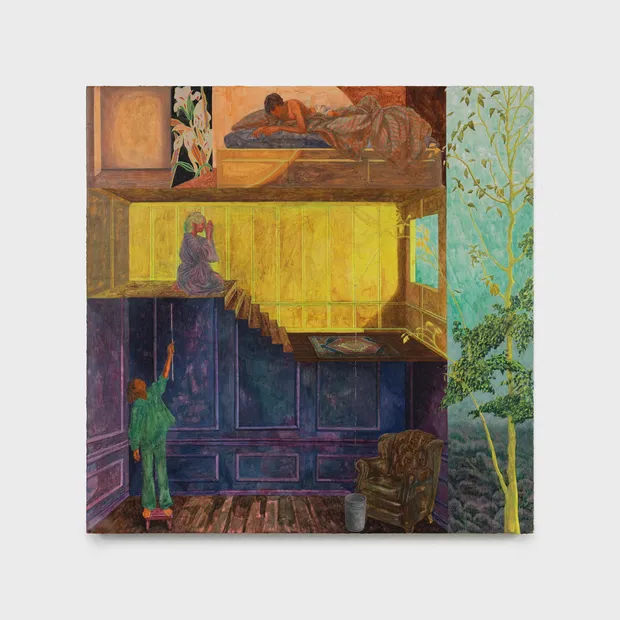
Rather, it is the work’s titular tree that embodies the sadness, weeping alongside the central figure, its tears symbolising a deep empathy. ‘This [work] reflects my belief that the solace found in nature can be more profound and soothing than human interactions,’ Yi explains.
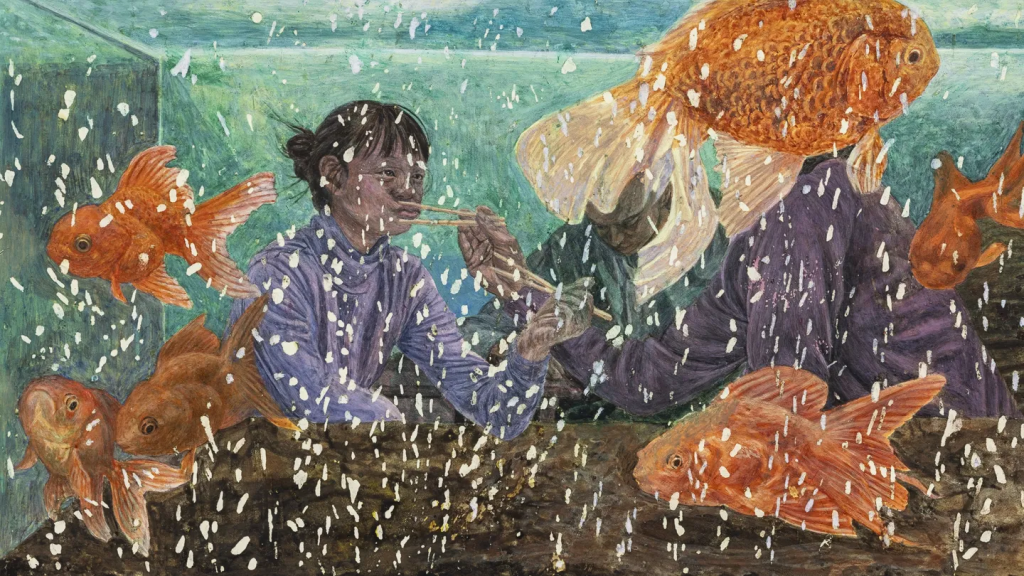
Intimations of sound also feature in Chattering Goldfish (2024), where diners sit at a wooden table behind a fish tank filled with giant orange carp. One figure playfully pinches another’s lips shut with chopsticks; behind them other figures sit in silence or might even be asleep.
‘In the foreground, I depicted the fish as if they were chatting, represented by air bubbles. This draws inspiration from an era of Japanese painting linked to the origins of manga, where thought and speech bubbles appear. Instead of using text, I convey the conversation through bubbles.’
Yi uses egg tempera, a medium she discovered while studying in the U.S. She was drawn to it for its resemblance to watercolour. ‘The process feels intimate—just you and the panel, doing fine, detailed work. It freed me from the pressures I felt with oil painting and allowed for more improvisation.’
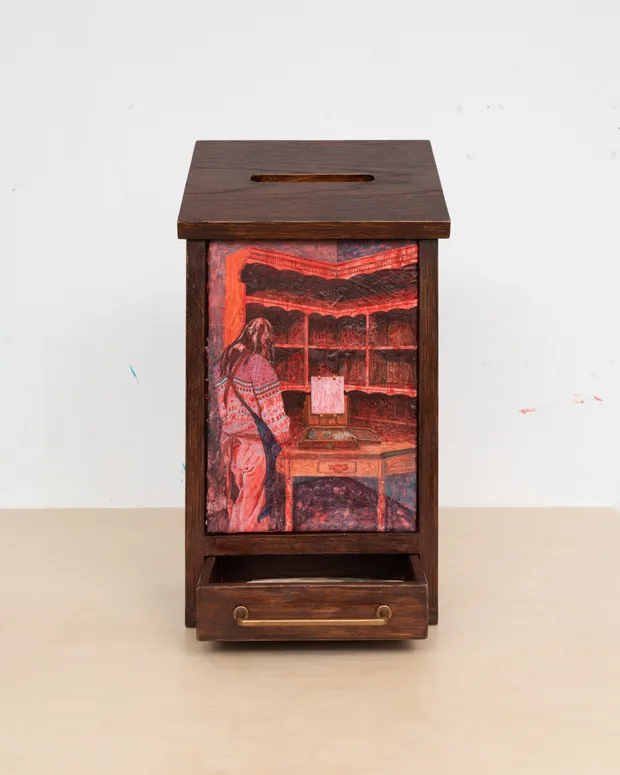
Often working on wood or spirit tablets—small wooden centrepieces symbolising the spiritual presence of the deceased—Yi emphasises gestures of interaction in her work. The sliding panels on the spirit tablets or the opening of drawers in her wooden box works evoke elements of theatre, revealing new acts and scenes based on our engagement with the objects.
Looking ahead, Yi is preparing for group shows at Long Story Short in New York this November and Frestonian Gallery in London in January 2025, along with solo exhibitions at MOU PROJECTS in Hong Kong and Long Story Short in New York later in 2025.
Main image: Miyeon Yi, Chattering Goldfish (2024) (detail). Egg tempera on wood. 21 x 50 x 2.5 cm. Courtesy the artist and LINSEED, Shanghai.